Guide
Do Vertical Mice Actually Help Wrist Pain? (2026)
By Vertical Mouse Guide Editorial Team · Updated 2026-03-29
By Vertical Mouse Guide Editorial Team
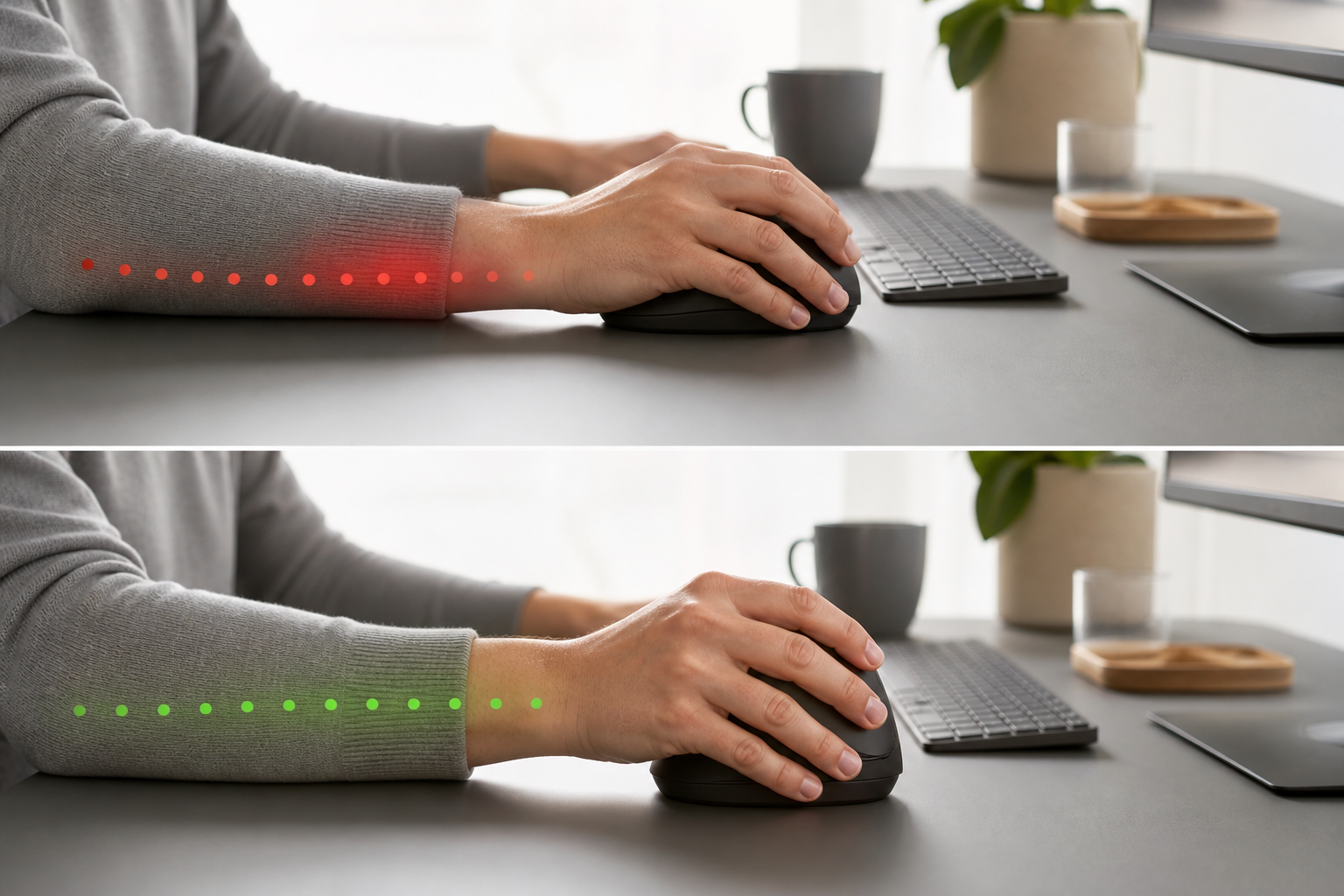
Vertical mice help wrist pain for most users whose discomfort is caused by forearm pronation — the palm-down rotation that standard mice force for hours daily. Research shows vertical grips reduce pronation by 50–90% and lower carpal tunnel pressure compared to flat mice. But they are not universal: if your pain comes from typing, grip strength issues, or conditions unrelated to mouse posture, a vertical mouse will not fix it. Here is what the evidence actually says.
The internet is split on vertical mice. Ergonomic blogs say they cure everything. Reddit skeptics say they are a gimmick. Neither is right.
The truth is more specific: vertical mice solve a particular biomechanical problem (forearm pronation stress) and are ineffective for everything else. If your wrist pain is caused by that particular problem, a vertical mouse helps — often significantly. If your pain is caused by something else, switching mice changes nothing.
This guide reviews the actual evidence, identifies who benefits and who does not, and compares vertical mice to four alternative solutions so you can make an informed decision rather than a faith-based purchase.
The Evidence: What Research Tells Us
 Infographic visual for The Evidence: What Research Tells Us
What Has Been Demonstrated
Research on vertical and semi-vertical mouse designs has established several findings with reasonable consistency:
1. Vertical grip reduces forearm pronation.
This is the foundational claim and the most robustly supported. Electromyography (EMG) studies measuring muscle activity in the forearm consistently show reduced pronator muscle activation when using a vertically oriented mouse compared to a flat mouse. The degree of reduction correlates with grip angle — steeper angles reduce pronation more.
2. Reduced pronation correlates with lower carpal tunnel pressure.
Biomechanical studies have measured intra-carpal tunnel pressure at varying forearm rotation angles. The consistent finding: neutral forearm position (handshake grip) produces lower intra-tunnel pressure than fully pronated (palm-down) position. This is the biomechanical link between vertical mice and carpal tunnel symptom relief.
3. Users report reduced discomfort.
Survey and questionnaire studies consistently find that users switching from flat to vertical mice report reduced forearm and wrist discomfort after an adjustment period. Self-reported discomfort is subjective, but the consistency across studies makes it meaningful.
4. Vertical grip changes movement patterns.
Motion analysis shows that vertical mouse users shift from wrist-based left-right movement (ulnar/radial deviation) to forearm-based pivoting (pronation/supination at the elbow). This changes which joints and muscles bear the repetitive motion load.
What Has NOT Been Proven
1. That vertical mice cure carpal tunnel syndrome. No study has demonstrated that a vertical mouse reverses median nerve damage or eliminates carpal tunnel syndrome. Symptom reduction is not the same as cure.
2. That vertical mice are superior to all alternatives. Head-to-head comparisons with trackballs, touchpads, and other ergonomic devices show that different tools benefit different users — no single solution is universally superior.
3. That everyone benefits. Studies consistently show a subset of users who do not experience improvement. The responder rate is high (most users benefit) but not universal.
4. Long-term injury prevention. No long-term prospective study has proven that vertical mouse use prevents the development of repetitive strain injuries in healthy users. The biomechanical reasoning is sound, but the direct clinical proof is lacking.
The Evidence Quality
The honest assessment: the evidence for vertical mice is moderate. Most studies are small (20–50 participants), short-term (weeks to months), and measure surrogate outcomes (muscle activity, pressure, self-reported discomfort) rather than clinical endpoints (diagnosed condition resolution). The biomechanical reasoning is strong and consistent, but the clinical evidence base does not meet the standard of, say, a drug trial.
This does not mean vertical mice do not work. It means the evidence supports them as a "biomechanically sound ergonomic tool with consistent user-reported benefit" rather than a "clinically proven medical treatment."
The Biomechanics: Why Vertical Helps
Setup visual for The Biomechanics: Why Vertical Helps
The Pronation Problem
When you use a flat mouse, your forearm is fully pronated — palm facing down. In this position:
| Anatomical Effect | Impact on Wrist |
|---|---|
| Radius crosses over ulna | Increases tension in forearm soft tissue |
| Pronator muscles are contracted | Sustained contraction → fatigue → pain |
| Carpal tunnel pressure increases | Median nerve compression risk rises |
| Wrist deviates ulnarly to move mouse | Carpal tunnel narrows on one side |
The Vertical Solution
A vertical mouse rotates the forearm toward neutral (handshake position):
| Anatomical Effect | Impact on Wrist |
|---|---|
| Radius and ulna approach parallel | Forearm soft tissue tension decreases |
| Pronator muscles relax | Sustained contraction eliminated → fatigue reduced |
| Carpal tunnel pressure decreases | Median nerve compression risk drops |
| Forearm pivots to move cursor | Ulnar deviation eliminated from mouse movement |
The Key Insight
A vertical mouse does not strengthen anything, heal anything, or treat anything. It changes the position of your forearm during mouse use from a stressful position to a neutral position. The body then does what bodies do when stress is removed — it recovers. Inflammation decreases. Nerve compression eases. Pain reduces.
This is why the benefit is most clear for people whose pain is directly caused by the pronated mouse position, and absent for people whose pain has a different cause.
Who Benefits Most
Detail visual for Who Benefits Most
Group 1: Pronation-Triggered Pain
Profile: Pain that starts during mouse use, worsens through the workday, and improves with rest (evenings, weekends, vacations). Located in the forearm, wrist, or hand. Often described as aching, tingling, or stiffness.
Why vertical helps: The direct cause of pain — sustained pronation — is eliminated. Remove the cause, reduce the symptom.
Expected benefit: Significant. Most users in this group notice meaningful improvement within 2–4 weeks.
Group 2: Mild-to-Moderate Carpal Tunnel
Profile: Occasional tingling or numbness in thumb, index, or middle finger. Symptoms respond to shaking out the hand, stretching, or rest. No grip weakness or muscle wasting.
Why vertical helps: Reduced pronation lowers carpal tunnel pressure, easing median nerve compression during mouse use. Combined with proper desk height and light grip, this can keep mild carpal tunnel manageable without medical intervention.
Expected benefit: Moderate to significant, especially combined with other ergonomic changes (desk height, wrist rest, breaks). For specific carpal tunnel mouse picks, see our best vertical mouse for carpal tunnel guide.
Group 3: Preventive Users (No Current Pain)
Profile: No current pain but uses a mouse 6+ hours daily in a pronated position. Understands that cumulative biomechanical stress increases RSI risk over time.
Why vertical helps: Reduces the daily pronation load on the forearm and wrist. Less cumulative stress = lower risk over time (biomechanically sound reasoning, though not clinically proven in long-term studies).
Expected benefit: No immediate symptom change (no symptoms to change). Long-term risk reduction — difficult to quantify but biomechanically logical.
Group 4: Previous RSI, Now Recovered
Profile: Had wrist pain or RSI, treated it (rest, therapy, bracing), and recovered. Wants to prevent recurrence while returning to full mouse use.
Why vertical helps: Reduces the biomechanical stress that contributed to the original injury. Lowers the chance of re-aggravation during the return to full workload.
Expected benefit: Moderate. Most valuable as part of a comprehensive return-to-work ergonomic setup (vertical mouse + proper desk + breaks + stretching).
Who Does NOT Benefit
Lifestyle visual for Who Does NOT Benefit
Group 1: Typing-Caused Pain
Profile: Pain that correlates with typing volume, not mouse use. Located in the fingers, wrists, or forearms. Worsens during long writing sessions. Mouse use is a secondary activity.
Why vertical does not help: The vertical mouse changes nothing about typing. Keyboard ergonomics (split keyboard, negative tilt, wrist rest) address typing-related pain. Changing the mouse for a typing problem is like changing shoes for a hat that does not fit.
Group 2: Severe Carpal Tunnel
Profile: Constant numbness, grip weakness (dropping objects), thenar muscle wasting, night symptoms that disrupt sleep. Diagnosed moderate-to-severe carpal tunnel syndrome.
Why vertical does not help enough: The nerve compression is too advanced for an ergonomic position change to meaningfully address. Medical intervention (injection, surgery) is typically needed. A vertical mouse may provide marginal additional comfort but will not resolve the underlying compression.
Group 3: Non-Pronation Wrist Conditions
Profile: Wrist pain from conditions unrelated to forearm pronation:
| Condition | Why a Vertical Mouse Does Not Help |
|---|---|
| De Quervain's tenosynovitis | Affects thumb tendons; not related to forearm rotation |
| Ganglion cyst | Structural; no amount of position change resolves a cyst |
| Wrist arthritis | Degenerative joint disease; not caused by pronation |
| Trigger finger | Tendon sheath issue; unrelated to mouse grip angle |
| Wrist fracture recovery | Structural healing; ergonomics are secondary to medical treatment |
Group 4: Already Using Low-Pronation Input
Profile: Already uses a trackball, vertical-ish ergonomic mouse (like the Logitech MX Master at ~25°), touchpad, or pen/stylus. Current setup already minimizes pronation.
Why vertical does not help: The pronation reduction is already achieved. Switching to a vertical mouse provides minimal additional benefit if the current device already reduces pronation.
Vertical Mouse vs 4 Alternative Solutions
Product Lineup visual for Vertical Mouse vs 4 Alternative Solutions
1. Vertical Mouse vs Trackball
| Factor | Vertical Mouse | Trackball |
|---|---|---|
| Reduces pronation | ✅ Yes (50–90%) | ❌ Most are palm-down |
| Eliminates wrist movement | ❌ Forearm still moves | ✅ Wrist stays stationary |
| Learning curve | 1–3 weeks | 2–4 weeks |
| Desk space needed | Normal | Minimal |
| Gaming suitability | Good for strategy/MMO | Limited |
| Best for | Pronation pain | Movement-repetition pain |
Verdict: If your pain is from the pronated position → vertical mouse. If your pain is from repetitive sliding motion → trackball. For a detailed head-to-head, see our vertical mouse vs trackball comparison.
2. Vertical Mouse vs Wrist Brace
| Factor | Vertical Mouse | Wrist Brace |
|---|---|---|
| Type of intervention | Ergonomic (positional) | Therapeutic (immobilizing) |
| When used | During work | During rest or sleep (ideally) |
| Addresses | Pronation, deviation | Inflammation, wrist flexion |
| Allows normal work | ✅ Yes | ⚠️ Limits dexterity |
| Medical supervision needed | No | Recommended |
| Best for | Prevention + mild symptoms | Active inflammation + moderate symptoms |
Verdict: Not competing solutions — complementary. Use a vertical mouse during work to reduce biomechanical stress. Use a brace at night to maintain neutral position and reduce inflammation during healing. Together, they address both the cause (daytime ergonomics) and the effect (nighttime recovery).
3. Vertical Mouse vs Ergonomic Keyboard
| Factor | Vertical Mouse | Ergonomic Keyboard |
|---|---|---|
| Addresses | Mouse-related wrist stress | Typing-related wrist stress |
| Pain trigger | Mouse use (moving, clicking) | Keyboard use (typing) |
| Cost | $25–100 | $50–200 |
| Best for | Mouse-heavy workflows | Typing-heavy workflows |
Verdict: Different tools for different problems. If your pain correlates with mouse use → vertical mouse. If it correlates with typing → ergonomic keyboard. If you do both heavily → get both.
4. Vertical Mouse vs Standing/Walking Desk
| Factor | Vertical Mouse | Standing/Walking Desk |
|---|---|---|
| Addresses | Hand/wrist/forearm position | Whole-body posture, sedentary load |
| Wrist-specific benefit | Direct (pronation reduction) | Indirect (can improve arm position) |
| Cost | $25–100 | $200–600 |
| Best for | Wrist/forearm pain | Back, neck, shoulder, and general health |
Verdict: A standing desk changes your overall posture but does not change your mouse grip. If you are using a flat mouse while standing, your wrist is still pronated. A vertical mouse at any desk height provides the pronation benefit. These solutions target different body regions and are complementary.
The Adjustment Trap: When It Gets Worse Before Better
Tips visual for The Adjustment Trap: When It Gets Worse Before Better
The most common reason people abandon vertical mice is the adjustment period. Here is the trap:
The Cycle
- You switch to a vertical mouse because of wrist pain.
- Days 1–7: New, different soreness appears — outer forearm, thumb base, between fingers. Your original wrist pain may be unchanged.
- You interpret the new soreness as "the vertical mouse is making things worse."
- You switch back to the flat mouse and the new soreness disappears.
- You conclude: "Vertical mice do not work for me."
The Reality
The new soreness is muscular adaptation, not wrist injury. The vertical grip uses different forearm muscles than the flat grip. Muscles you have not used intensively are now working for hours. They ache. This is the same mechanism as starting a new exercise — delayed onset muscle soreness (DOMS) from unaccustomed activity.
Your original wrist pain (from pronation) may take 2–4 weeks to improve because the accumulated inflammation needs time to resolve even after the aggravating position is removed. Meanwhile, the new adaptation soreness arrives in days 1–3. The overlap — old pain still present, new soreness added — creates the false impression that things are worse.
How to Navigate It
- Expect new muscle soreness for 1–2 weeks. It is normal, not harmful.
- Monitor your ORIGINAL symptoms separately. Are the tingling, numbness, or aching that prompted the switch improving? Track these specifically.
- Use the vertical mouse 3–4 hours per day in week 1 to limit adaptation soreness. Increase gradually.
- If original symptoms improve even slightly by week 3, the vertical mouse is working. The adaptation soreness will fade on its own.
How to Tell If a Vertical Mouse Is Helping You
The 4-Week Test
| Week | What to Track | Good Sign | Bad Sign |
|---|---|---|---|
| Week 1 | New adaptation soreness | Appears days 1–3, improves by day 5 | Adaptation soreness worsens daily without plateau |
| Week 2 | Original symptom baseline | Tingling or aching slightly less by end of day | Original symptoms unchanged or worse despite adaptation fading |
| Week 3 | End-of-day comparison | Noticeably less discomfort than pre-vertical baseline | No improvement in any metric |
| Week 4 | Overall assessment | Clear improvement in original symptoms | No improvement → vertical mouse is not addressing your cause |
What Improvement Looks Like
- Tingling occurs later in the day (or not at all) compared to flat mouse baseline
- End-of-day forearm aching is reduced or eliminated
- You no longer shake out your hand to relieve numbness during work
- Weekend recovery happens faster — symptoms clear by Saturday morning instead of Sunday
- You unconsciously forget about your wrist during work (the best sign)
What Non-Improvement Looks Like
- Symptoms are identical to your flat mouse baseline after 4 weeks
- Adaptation soreness has faded but original pain is unchanged
- Tingling and numbness still occur at the same frequency and intensity
- You still need to shake out your hand at the same intervals
If you see non-improvement after 4 weeks of correct use (right mouse size, right desk height, light grip, 4+ hours daily), the vertical mouse is likely not the solution for your specific pain. Explore alternatives: trackball, touchpad, ergonomic keyboard, or medical evaluation.
When a Vertical Mouse Can Make Things Worse
In rare cases, a vertical mouse genuinely worsens symptoms. Three scenarios:
1. Wrong Mouse Size
An oversized mouse forces the hand to stretch and grip harder. This increased grip force compresses the carpal tunnel from outside — potentially increasing median nerve pressure even though pronation is reduced. The net effect can be worse than the original flat mouse.
Fix: Size the mouse correctly. For sizing guidance, see our best vertical mouse for small hands guide or best vertical mouse for large hands guide.
2. Excessive Grip Force
Some users grip the vertical mouse tightly during the adjustment period — anxious about the new grip, trying to maintain precision on unfamiliar geometry. Tight gripping compresses the carpal tunnel and strains the finger flexors. The harder you grip, the less benefit the vertical angle provides.
Fix: Consciously relax your grip. The mouse should rest in your hand — not be held by your hand. If it slides, it is too steep for your desk surface (add a mouse pad with grip) or the wrong size.
3. Lateral Epicondylitis (Tennis Elbow)
The vertical grip shifts mouse movement from wrist deviation to forearm rotation. If you have lateral epicondylitis — inflammation of the tendons on the outside of the elbow — the forearm pivot motion of a vertical mouse may aggravate those tendons. In this specific case, a flat mouse (with wrist-based movement that avoids elbow rotation) or a trackball (which eliminates forearm movement entirely) may be less aggravating.
The Honest Recommendation
If You Have Wrist Pain:
- Identify the trigger. Does pain correlate with mouse use, typing, or both? A pain journal for one week (note activity, pain level, and time) reveals this.
- If mouse-triggered: Try a vertical mouse. The Anker Vertical Ergonomic Mouse ($25) is the lowest-risk test. Use it for 4 weeks with proper desk height and light grip.
- If it helps: Consider upgrading to the Evoluent VerticalMouse 4 or Logitech MX Vertical for better build quality and more pronation reduction.
- If it does not help after 4 weeks: The pain cause is likely not pronation-related. Explore trackball, ergonomic keyboard, or medical evaluation.
- If pain is severe (constant numbness, grip weakness, night waking): See a doctor. No mouse is the answer.
If You Have No Pain But Want Prevention:
A vertical mouse is a reasonable, low-risk ergonomic improvement for anyone using a mouse 4+ hours daily. The biomechanical reasoning for reduced cumulative stress is sound. Start with the Anker ($25) or MX Vertical ($90) depending on budget. For how vertical mice compare to regular mice on ergonomics, see our vertical mouse vs regular mouse guide.
Frequently Asked Questions
Do vertical mice actually help wrist pain?
For pronation-related pain (caused by palm-down mouse use), yes — most users experience meaningful relief within 2–4 weeks. For pain caused by typing, medical conditions, or non-pronation factors, no.
What does the research say?
Research consistently shows vertical mice reduce forearm pronation and users report reduced discomfort. The evidence is moderate — biomechanically sound with consistent user-reported benefit, but limited by small study sizes and short-term follow-up.
Who benefits most?
People whose pain is triggered by mouse use and improves with rest. Mild-to-moderate carpal tunnel sufferers. Preventive users with heavy mouse workloads.
Who does NOT benefit?
Typing-caused pain, severe carpal tunnel, non-pronation wrist conditions (de Quervain's, cysts, arthritis), and users already on low-pronation input devices.
Vertical mouse or trackball for wrist pain?
Different mechanisms. Vertical reduces wrist position stress (pronation). Trackball reduces wrist movement. Try both — whichever reduces your symptoms more is the right choice.
How long before it helps?
2–4 weeks. Week 1 may feel worse (adaptation). Week 2–3, adaptation fades and original symptom improvement emerges. If no improvement at 4 weeks with proper use, it is not addressing your cause.
Can a vertical mouse make pain worse?
Rarely. Three causes: wrong size (forces grip strain), excessive grip force (compresses carpal tunnel), or lateral epicondylitis (forearm pivot aggravates elbow tendons). Fix by sizing correctly and gripping lightly.
Is a vertical mouse better than a wrist brace?
Complementary, not competing. Vertical mouse during work (reduces biomechanical cause). Brace at night (supports healing). Together, they address cause and effect.
Sources & Methodology
This guide reviews the evidence for vertical mouse effectiveness in reducing wrist pain based on published research, biomechanical principles, and ergonomic guidelines.
Medical and Ergonomic References:
- Mayo Clinic: Carpal Tunnel Syndrome — pathophysiology, causes, and treatment — mayoclinic.org
- OSHA: Computer Workstation eTool — input device ergonomics and workstation design — osha.gov
- NIOSH: Ergonomics and Musculoskeletal Disorders — workplace ergonomic risk factors — cdc.gov/niosh
Biomechanical Research:
- EMG studies on forearm muscle activity at varying mouse orientations: consistent finding of reduced pronator muscle activation with vertical orientation
- Intra-carpal tunnel pressure studies: neutral forearm position produces lower pressure than pronated position — established biomechanical finding
- Motion analysis: vertical mouse use shifts cursor movement from wrist deviation to forearm pivot — documented in ergonomic research
Evidence Assessment:
- Research base is moderate: most studies are small (20–50 participants), short-term (weeks to months), and use surrogate outcomes (EMG, pressure, self-reported discomfort) rather than clinical endpoints
- Consistent direction of effect (positive) across studies increases confidence despite individual study limitations
- Absence of large, long-term randomized controlled trials means clinical claims should be stated as biomechanically supported rather than clinically proven
Methodology notes:
- "Who benefits" and "who does not" categories based on biomechanical reasoning — which pain mechanisms vertical mice address and which they do not
- This guide provides ergonomic and health information, not medical advice. Consult a healthcare provider for diagnosis and treatment of wrist pain or carpal tunnel syndrome
- We may earn a commission on purchases at no additional cost to you; affiliate relationships do not influence recommendations
Internal links referenced: